The other day I saw a question from a fairly new weaver asking about getting a 45 degree angle on their weft and the answer was to do the best they could.
Ahem.
It’s impossible.
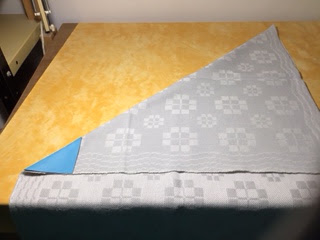
The photo is a tea towel I wove, about 24″ in the reed, finished width of 20.5″.
When I folded it so that a 45 degree angle could be shown, the photo shows what that 45 degree angle would look like in the shed. The side height of that angle is 20″ tall. Therefore, for that 24″ in the reed warp? The shed would have to be in excess of 20 inches long in order to lay the weft into the shed at a 45 degree angle.
I *think* people conflate the 45 degree angle suggested as the ideal for a twill line in the cloth with the angle the weft should take in the shed. When that is clearly impossible.
(The cyan triangle is my little 45 degree gauge I use to check my twill angle.)
So what should a new weaver do?
First of all, understand that the angle that is used should be appropriate for the cloth being constructed.
My general angle of weft in the shed can be as low as 5 degrees, to around 15 degrees.
It is much more important to NOT trap the active/live end of the yarn in the selvedge.
So. Once the shed is opened, throw the shuttle, giving a tiny ‘tug’ on the weft yarn to seat it around the selvedge.
Then let off any pressure on the bobbin and as you bring the beater forward, lift the hand with the shuttle just enough for the beater to pass beneath your hand.
As the beater comes forward to press the weft into place, the weft will find a natural balance point through the cloth and the actual *angle* it has been laid in doesn’t much matter.
There are even times when I will keep tension on the weft in order to increase draw in – for a particular purpose.
But mostly, I just try to be as consistent as possible and allow the weft to find it’s natural place in the cloth and not bother too much about the actual angle. But if a guideline is needed, around 10 degrees.
If you don’t have a protractor, you can make a rough one by folding the little 45 degree angle in half, which will give about 22 degrees, then fold the 22 degrees in half for about 11 degrees.
Rather than fuss too much about angle of weft, though, I would encourage new weavers to learn how to wind a ‘good’ bobbin (yes, under tension, smoothly wound), practice their shuttle handling skills, hold the shuttle in the cradle of their fingers using their thumb to break the cast off of yarn, lifting their hands so the beater travels beneath the hand, and be as consistent as possible every step.
Developing a good rhythm will help as each movement flows smoothly into the next.