There are a plethora of ‘can’t’ and ‘won’t’ ‘rules’ involving weaving. They pop up, over and over again.
The thing is, most of the ‘can’t’ comments are fall mostly under ‘won’t’. Because in many instances, you *can* do something. But there are times when doing one of the ‘can’t’s will result in less than desirable results.
Unless you know the ‘key’ to doing it so that you wind up with desired results.
Take the ‘you can’t weave with handspun’, sometimes rendered as ‘you can’t weave with hand spun singles’.
Well, you can, actually. IF you understand the nature of your yarn and make sure that you are choosing yarn that will ‘work’ as warp.
How do I know? Because I’ve done it.
I wanted to explore the parameters of how much twist was needed in order to make a hand spun singles yarn that would actually ‘work’ as warp. So I talked to a spinning friend and she agreed to do the technical work of making the yarn – same fibre (merino), spun to the same grist (thickness) but varying the degree of twist to find the threshold of when it would ‘fail’ as warp and when it would ‘work’.
Turned out the number of twists per inch for that fibre at that grist was something like half a twist per inch.
If our ancestors did the work and figured out how many twists per inch at a particular grist would work why would they take the time to ply the yarn to ensure that it would work? Why double the amount of yarn needing to be spun, then plying it, before having yarn to weave with? And having something thicker than you needed for the quality of cloth you wanted to make? Not to mention the other changes that come from using a 2 ply rather than a single?
Then, there is the aspect of using a warp ‘dressing’ to strengthen the yarn. For wool, gelatin could be used, for linen, flax goo. Other things could be used – starches from various sources – rice flour, wheat flour, potato starch – I’ve heard about a number of different things.
Personally I’ve used gelatin on wool, and flax goo on linen. They work. They make a mess and the yarn becomes *very* stiff and not very pleasant feeling, but they *do* work.
I prefer to *not* apply a dressing if I don’t have to. But since I have an understanding of the correlation between twist and ‘strength’, I prefer to choose yarns that are already spun strong enough to use, as is.
This whole topic of ‘good’ and ‘bad’ yarn is on my mind because the first of the seminars is titled A Good Yarn and I will be discussing things like this during the seminar.
If you are attending and have questions, be sure to bring them on Sept. 13. I’ll do my best to answer them.
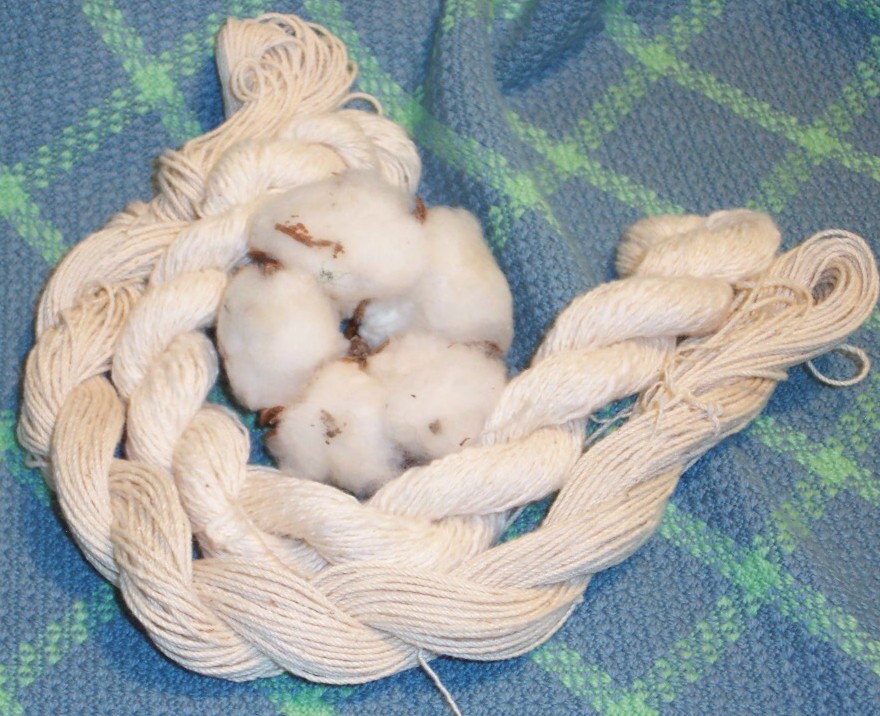
photo of cotton fibres
Leave a Reply