
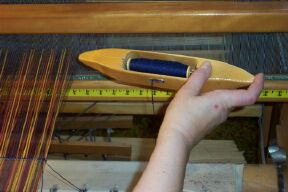
I see videos on line all the time from people who urge weavers to use ergonomic motions and position/posture. And then demonstrate methods that aren’t actually all that ergonomic.
Who am I to tell people what to do? Well, I’ve confirmed what I worked out mostly on my own after a good grounding by my very first weaving teacher, with a number of specialists – from physiotherapists, to massage therapists, to specialists in body mechanics. I’ve also had weavers who experienced injuries and had their therapists confirm what I’m suggesting as being ‘good’ processes once they recover from their injuries.
I’ve written about these things for literally decades – and had people debate me on the validity of what I say. But here’s the thing – weaving is a craft practice that requires multiple repetitions of the same movements over and over again. If done too long (each person has their own limit) the muscles get fatigued; when they get fatigued they begin to develop inflammation, and once the inflammation becomes chronic you have injury.
And it is *much* easier to prevent repetition motion injuries than to recover from them.
How you hold your shuttle – should be in the thumbs up position. I have videos about how to hold and throw the shuttle on You Tube. You can do a search using Laura Fry Weaving. There are over 20 short videos. I try to get straight to the point and show the motions. Now I’m not a videographer, and they aren’t always the best quality of video. If you want better video, I have classes on Long Thread Media and School of Sweet Georgia.
As for position and posture at the loom, you should be sitting so that your hips are higher than your knees. Perch at the edge of the bench, on your sitz bones. That means a pelvic rotation that brings your bottom up off your tailbone and onto the sitz bones.
Your shoulders should be ‘neutral’, not hunched up around your neck. Your spine should be in a ‘natural’ curve, not hunched over. Doing that pelvic rotation and sitting on your stiz bones will almost automatically achieve that.
Your elbows should be higher than the breast beam.
All of your motions should be ‘small’ – not exaggerated.
The goal is to *not* injure your body in the practice of your craft.
Take rest breaks. That doesn’t mean stopping weaving – it may mean going to wind a few more bobbins. Or work on your next warp, picking colours, drawing out your stripe designs to see which one you want to use, cleaning up your studio. Just rest your ‘weaving muscles’ by giving them a break and doing something else. Or just sitting and having a cup of tea. Read that new issue of WEFT, or a new weaving book. Whatever.
Pay attention to your body. If you start making mistakes, dropping the shuttle, not following your treadling so that you have to unweave…whatever…try taking a break and coming back to the loom later, refreshed.
Happy weaving…

Leave a Reply