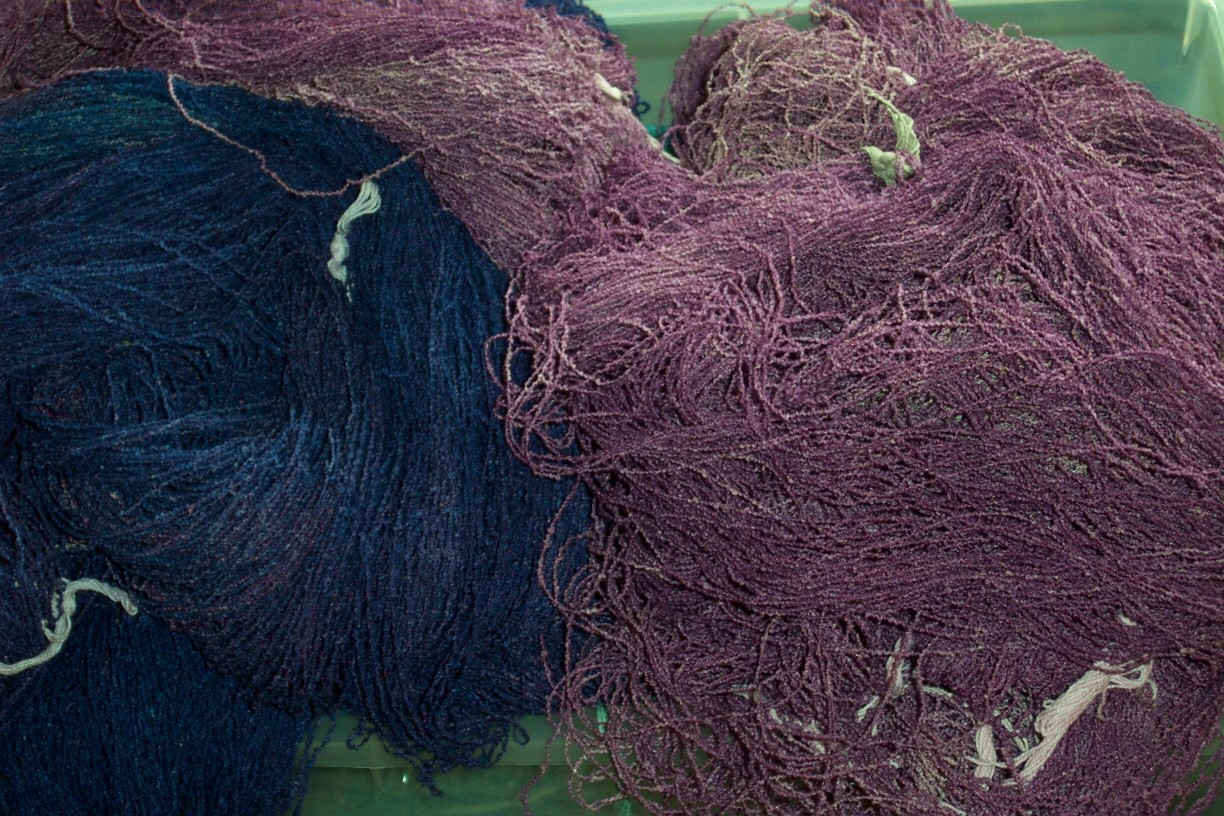
The last 12 silk gimp warps – yes I know they look scary but really they are pussy cats once under tension.
I’ve been thinking a lot lately about ‘perfection’. I know that we all strive for it but in my case at any rate, I rarely achieve it. The best I can get, usually, is good.
So I’ve been thinking about why ‘perfection’ is so difficult to achieve in the construction of textiles.
Partly, I think, it is because there are so many variables. Change any one thing and everything changes.
Add to that the fact that what we are essentially trying to do is exert control over a tangle of threads, each one quite willing to act and react as an individual and is it any wonder we (or at least, I) so seldom see perfection appear?
The first thing we have to do is get those individual threads to co-operate. Then they need to adhere to a compromise and reach consensus on things like length and tension during the dressing of the loom. Once on the loom they need to co-ordinate with it during the actual weaving in order to create good clear sheds for the shuttle to pass through. And all of this is achieved through consistency.
Weaving truly is a process, first and foremost. Perfection is a happy consequence of all of the above going well plus good choices in terms of yarn, colour, weave structure and wet finishing.
The search for perfection is what keeps me intrigued, fascinated and motivated to keep going back to the loom again and again. If it were easy to reach perfection it wouldn’t be nearly so frustrating or challening or, ultimately, satisfying.