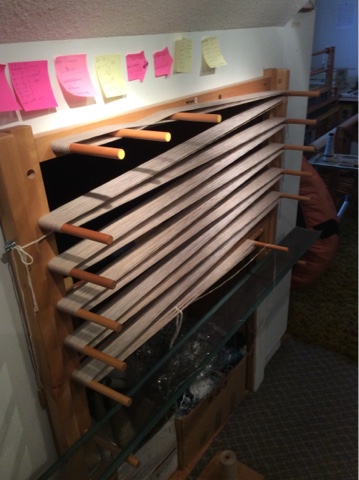

A lot on my mind, so warp winding, leaving some ready for me to slam onto the loom when I get home seemed like a good idea.
Seems like there is a surge in people interested in weaving happening all over the country, which is great. It also means a flood of people trying to learn a craft that is subtle and nuanced, usually re-inventing the wheel. They are either far away from personal assistance or on a very limited budget, not wanting to buy books or DVDs or travel to take classes.
Inevitably they run into problems and wind up with disasters, disappointed in their results, not understanding that weaving takes a certain level of knowledge and skill, which doesn’t come on the first or even 31st stab at it.
They wind up being afraid, tense, wary. They tend to use what I call a belt and suspenders approach to the craft, often doing things more slowly than necessary, partly because they just haven’t given themselves enough time to practice the physical skills or have enough knowledge to know when extra time needs to be taken in order to get good results.
So often warp winding becomes a problem because they hold the thread with a death grip. If they wind more than an inch worth of warp the first threads are longer than the last because the extreme tension they are using causes the pegs to bend. Or they can’t get the warp chain off the board it is so tightly wound.
They use massive numbers of ties along the length of the chain and tie the cross round the waist as well as the arms.
All of those ties take time, both to tie…and untie. Frequently I see ties made from one strand of very thin thread, tied loosely. To me this is not helpful, especially if the ties are the same colour as the warp. A loose tie really doesn’t do much except prevent the chain from spreading.
A new weaver must first of all learn the vocabulary and physical skills including how to most effectively handle their tools. The definition of ‘effective’ will vary with each person, so learning a variety of approaches is imho necessary. The more the weaver knows, the better able they are to choose appropriately. And to know when belt and suspenders are necessary. And when they are not.