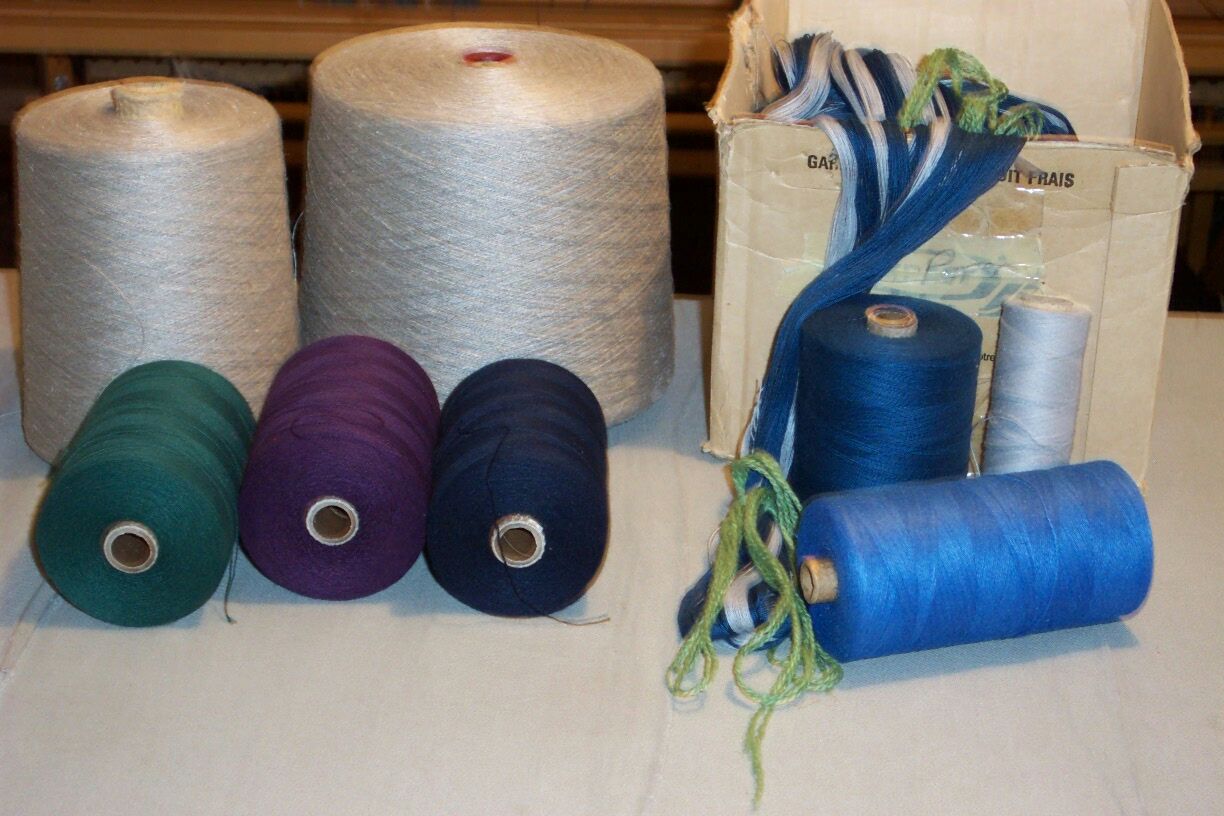
next two tea towel warps for the Fanny loom
Efficient: Productive of effect; competent, capable
Efficiency: State of quality of being efficient; ratio of useful work done to total energy expended
The Concise Oxford Dictionary
My priorities in terms of weaving are to a) make functional fabrics that will fulfill their function with beauty and grace; b) to make these fabrics as efficiently as possible so that I can make more. Lots more. I have so many ideas that to linger over any one design – especially due to equipment difficulties – is frustrating. (We won’t discuss operator error – those are inevitable and irritating in the extreme!)
Once I have decided on a design, I then think about how to bring that fabric into material form (pun most definitely intended!) as quickly as possible.
Let’s face it – creating fabric from yarn is labour intensive. Unless you are weaving with pure gold or something like that, the biggest investment in the creation of cloth is the time required to make it.
Weaving is also repetitive by its very nature. Winding a warp, threading it, throwing the shuttle – all are motions that are repeated hundreds if not thousands of times.
That is why, when I have students who want to become more efficient, I tell them that it is a matter of shaving nano seconds off of the movements. Those nano seconds add up to seconds, which add up to minutes, which can literally add up to hours. (Follow Tien Chiu as she weaves her wedding dress http://tienchiu.com/ and how many thousands of repetitions she will make to create her dress and coat ensemble)
Of course any process must not decrease the quality of the cloth – that is, by definition, not efficient! OTOH, whilst one is learning a new process, there will be mistakes made until the new process is learned. One must balance the future benefits against the slippery slope of the learning curve and be willing to un-learn muscle memory and replace it with the new motions.
It is also a matter of choosing equipment and tools that are efficient. I have rejected looms and shuttles and other tools of the trade because they were simply not efficient. Yes, it only took a few seconds longer to thread the weft through the slot in that particular shuttle, but when I do that particular task dozens of times in a day, those seconds start to add up.
I have rejected shuttles because they did not fit into my hand so that I could hold and throw them efficiently. Shuttles were rejected because – although they were very pretty, made with amazing exotic woods, shaped and polished so that they glowed and felt like satin – their shape caused them to curve as they were thrown such that I could not catch it properly. Again – nano seconds, but when I throw the shuttle hundreds of times a day, I don’t care how pretty it is. I do care that it works smoothly and efficiently.
Looms that would make amazingly beautiful furniture that would look ‘nice’ in a living room were rejected because they didn’t work terribly well, meaning that each action of the loom was slower than I need in order to weave at my pace.
I do time studies for several reasons. One of which is to find out how long it takes to do a particular task. Having this information allows me to make the most of the time I have available. If I have 15 minutes, I know that I can’t dress a loom in that time, but I do know that I can wind bobbins, or sley a scarf warp, or work on number crunching a stripe sequence for my next warp.
If I have a customer with a tight time frame for an order, I have a good idea if I can squeeze that warp into my schedule and deliver on time, all because I know how long it takes to wind a warp of about that particular size, dress the loom and weave the cloth.
So yes, issues of efficiency are pretty high on my list, but paramount is the goal of making a functional textile that will serve it’s function with beauty and grace. Beauty being in the eye of the beholder, I can only hope that others will agree with my choices.
Currently reading The Three Sisters by James D. Doss