Yesterday I commented that two different cotton yarns listed as being the ‘same’ size (ie same number of yarns per pound) were NOT the same quality of yarn. That ONLY paying attention to the ‘count’ does not address the qualities of the yarns, which are very different.
Someone pointed out that Tencel spun to the same count is not the same thickness, and I agree. In fact I have the ‘proof’. Which is why you can’t always ‘count’ on the count but need to work with the yarn itself to fully understand it.
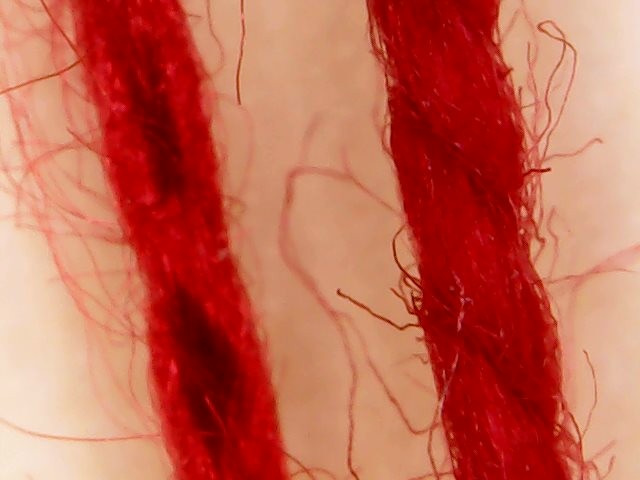
The above photo is another digital microscope photo with 2/8 Tencel on the left, 2/8 cotton on the right.
Tencel is a denser fibre than cotton. By rights, I submit the ‘count’ used should have been the linen count. Or, better yet, one of the metric sizing counts.
To know the ‘count’ of a yarn is NOT to ‘know’ every quality of said yarn.
When Tencel first appeared on the scene the standard advice was to use the same epi as the cotton count yarn.
However.
Tencel is regenerated cellulose, an extruded fibre, very smooth and slippery. Since it is denser than cotton, the resulting 2/8 (or 8/2 if you prefer) yarn wound up *thinner* than cotton spun to the same count.
Given it is thinner, and slippery-er, than cotton, a lot of people were making cloth that wasn’t particularly stable, wondering why they weren’t getting good results.
And that, my darlings, is why we sample. The count of the yarn is merely the introduction. A hint. A place to start, to begin to understand the nature of the yarn.
We have to use our eyes, our fingers, our brains, to analyze and begin to understand the yarns we work with.
And that is why there is not a hard and fast rule about what epi to use for *any* yarn – it’s a spectrum. You can take the exact same yarn, set it densely, openly, or somewhere in between, adjust the number of interlacements by changing the weave structure and/or the treadling. In some cases, I have added a plain weave pick between the weave structure picks to increase stability and make a lighter weight cloth.
Generally the difference will be slight, more felt in the hand than seen by the eye.
It’s why I have binders of samples using the *same* yarn, at different densities, fulled (when it is wool) to different degrees.
And yet, I STILL sample.
Because what we want and how we get there is a moving target.
I’ve been saying this online since 1994. I feel like a broken record. (Since vinyl is making a comeback, I feel like I can start using this phrase again.)
When ordering yarns online, don’t just look at the count. Compare the yards per pound. Then be prepared to adjust once you have the yarns in hand and can weave samples!
The field of textiles is not just a world but a galaxy.
Each weaver needs to study their own processes, equipment and materials to find out how to work with them to make the quality of cloth they are aiming for.
Qualities such as: absorbency, abrasion resistance, drape, insulation, etc., can all be affected by the yarn chosen, the weave structure, density. The list goes on.
If a weaver chooses to follow another weaver’s advice, be prepared to adjust things to meet their own objectives. What works for one may not work for another! Change the width and the epi might need to be changed. Or change the number of interlacements – more and the cloth will be more structural sound, but it might also be stiffer. Fewer and the cloth will have more drape but may not withstand abrasion as well. Does that matter? Depends! Depends on the ‘job’ the cloth is to do.
Ultimately not every single weaver needs to understand the craft to the depth of the bones, but some need to in order to develop the ‘recipes’ others will depend upon. If a weaver wants to provide ‘recipes’ then the instructions need to be written with clarity.
So I keep preaching to the choir. Learn. Dig deep. Find out *why* something is happening. Know how to fix problems when they arrive. Understand that sometimes ‘good’ is actually ‘good enough’.
Do not be put off by the enormity of the task, but embrace the learning journey. Be willing to make mistakes. Do the best you can until you know better; when you know better, try to do better.
I included some of the variables in The Intentional Weaver, if anyone wants to take a deeper dive into yarn characteristics. I was hoping every guild with a library would purchase the book for their members to use. If you have a copy and find it useful, you can go to the Sweet Georgia Yarns website and leave a review on their page. They still have 7 signed copies in stock.