It doesn’t do to get complacent – that’s when you stop thinking.
This warp is 36 epi. I have a 9 dent reed, but it’s very old and rough on the top and bottom so when I checked my stored reeds I noticed that I also have a brand new metric reed (35) which is also 9 dents. Without thinking too much I popped that reed into the beater and proceeded to sley it. The entire time I was sleying it I did not once stop to ask myself why I hadn’t been using this reed, but the old battered one. Or if I did, I didn’t take the time to properly answer the question.
Turns out that the reed is too ‘short’. When I put the beater top back onto the beater, there was a 1/2 inch gap between the reed and the top.
Now, you may be asking yourself how it is possible for me to put the reed into the beater without putting the top of the beater on. The answer is simple. On the AVL, the bottom of the reed is ‘pinched’ between two pieces of wood. And, since the beater top is rather large and blocks the view in order to sley, I leave it off while I do that job.
I really dislike having to change reeds and resley because all my nice neat little bouts which I so carefully tie into slip knots are now gone and the danger of making sleying errors is much, much greater when the warp ends are all loose.
However since I was not resleying to change the density, merely changing one reed of the same dents per inch to another of the same dents per inch, I realized that instead of pulling the warp out of the wrong reed entirely, I could transfer each group dent by dent which would mean the risk of sleying errors would be low.
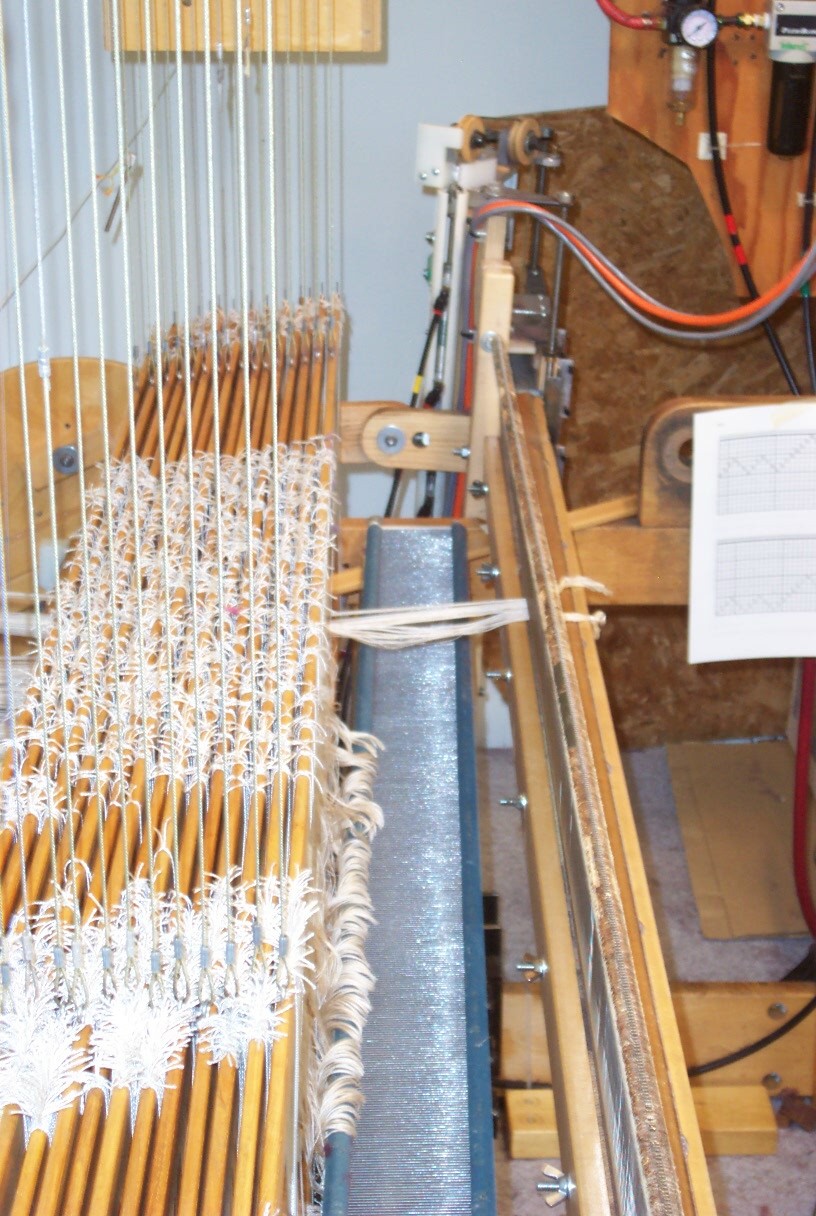
How to do this when the AVL doesn’t really have side frames that the reed could lay on? I grabbed a couple of short lease sticks (for the Leclerc Fanny or other smaller loom) and rested them on each side of the loom across the bottom of the shafts and onto the side frame of the loom. And taped them there. The reed rests quite comfortably there and it’s only taking me a few minutes to pull each group in it’s order and put it into the reed which is clamped in the beater.
If you click on the photo you should be able to see the set up more clearly.
Once the reed is completely re-sleyed I’ll carefully pull the reed out and remove the sticks and then I can go ahead and put the loom back together (the sandpaper beam is also out of the loom), tie on and ought to be weaving this afternoon. 🙂
And I can be pretty sure there are no sleying errors to fix. But just in case, I’ll be sure to check each shed. Doesn’t do to get complacent!
Currently reading Snuff by (Sir) Terry Pratchett