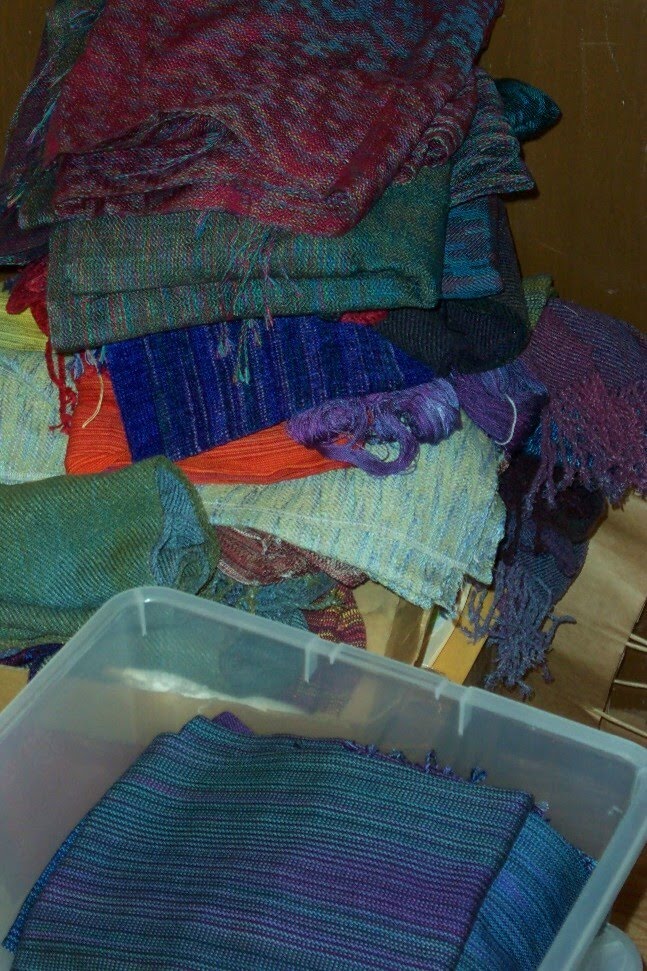
Mt. Finishing – good thing Mizz B got 7 more shawls fringe twisted as I sold all except one this weekend….
It was an interesting weekend.
Saturday Mizz B came to mind my booth so that I could attend the 70th bd of a dear friend. While there I was chatting with some of the other weavers in the crowd and it came out that I was the ‘baby’ of the group. Not something you really think about when you’re 60. 🙂
(You hear that Syne? 60 is young in the weaving world!)
On Sunday I had a chat with one of the other exhibitors. Actually I’d had much the same chat with a couple others during the weekend. The one where we all confessed to feeling very tired after a 20 or 30 year stint of designing, making product and schlepping it across the country to sell it. Because it isn’t good enough to just make it when you’re dependent upon sales of your hand made items – you’re not done until the customer has paid you for it and taken it to a new loving home.
At any rate, the chat on Sunday morphed into an analysis of the change in the nature of craft fairs – how there were fewer and fewer designer/makers around – potters, glass artists, woodworkers, weavers. We wondered where the next generation would come from because it seems like the majority of 20 somethings have no interest in throwing a thousand mugs, or weaving a hundred placemats (or scarves etc). They want a product now and they don’t want to have to spend years honing their skills to get it.
Or at least, that’s how it seems. Especially when we looked around the show and counted up the number of food booths, the number of personal care product booths, the jewellry (strung beads) and other things that aren’t counted in amongst the ‘traditional’ hand crafts.
(Mizz B is most definitely the exception and I treasure having her in my life.)
The feeling that people don’t want to spend time learning the craft comes partly from the proliferation of new weavers who have no interest in sampling (they can’t ‘afford’ to sample) and want instant success with proven ‘recipes’.
Part of that sense comes from my experiences on the internet chat groups and other feedback I’ve personally had.
For example. After reading multiple posts from people who either don’t have a local guild or, due to family/work commitments can’t make it to meetings, I offered to start a study group list. The deal was that people could join the list (run through my website) for free, but if they wanted to participate in the sample challenge/exchange, I requested that those people pay a fee to help cover my expenses.
One person emailed to tear a strip off of me. Who, she fumed, did I think I was asking to be paid for something freely available at local guilds?????? (I’m paraphrasing here because I no longer have that email, but that was the gist. And she went on at great length to let me know I was not amongst her favourite people.)
There were many things I could have said in reply, but I chose to ignore her email and carry on with the plan.
So I know that there are some people who do want to learn. Who do want to understand. Who are willing to put the effort into honing their skills. But will there be enough of them to keep the craft alive and healthy? If the only designing (making up of recipes/kits) is being done by a tiny minority of weavers, will general knowledge – as thinly scattered as it currently is – eventually fade away?
Weaving has been going on by human beings for in excess of 30,000 years according to new archeological finds. Will it last much longer?
Just finished Mockingjay by Suzanne Collins and started The Madness Of Lord Byron by Stephanie Barron