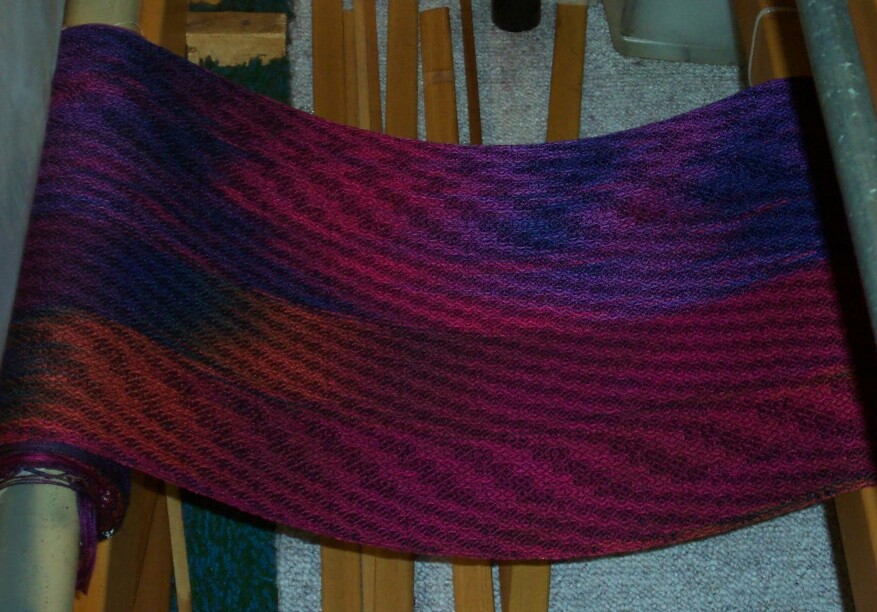
 Shawl #3 at the back of the loom.
Upon finding out that I am a weaver, so many people exclaim “Oh you must be sooooo patient!”
Er – actually – Not!
I am probably the least patient person I know………
During a discussion with Tien we both agreed that when one has deemed something necessary, no patience is required. You do what you have to do to obtain the results desired.
We did not discuss the other side of the equation, probably because we would have agreed on that, as well.
In other words, why would I do something that wasn’t necessary?
The answer to this simple question – is what I am doing necessary or not? – has meant that at times I have ditched an entire warp. The biggest fiasco was a 30 yard long warp that was giving me fits right from the get go. We won’t go into why – I don’t like to air all my dirty laundry in public – let’s just say that after fighting with it getting it beamed, threading it (48″ in the reed, double weave warp of 2/8 cotton), I could tell within the first 6 inches of weaving that disaster lay that way.
So I cut it off the loom and threw it away and started over from scratch. (That didn’t exactly make me a happy camper, understand – just that I knew when to cut my losses.)
My time is precious because it is limited. It is also the largest investment I make in my textiles. It is not worth it to me to expend dozens of hours on a warp that might cost me $200 or even $500 for materials when the cost of my time could multiply out into a much much greater sum.
It is the same with the processes I use in weaving. Why would I spend 10 hours beaming a warp using one method, when I can beam the same warp in half or a quarter (or less) of that time?
As Syne phrased it – I don’t want to work artifically slowly. (Love that phrase Syne, I’m keeping it!)
So I have spent much of my career fine tuning and honing my physical skills. I have learned when ‘good enough’ is just that – as Margaret phrased it “Perfect kills good”. When we over work something, we can wind up with a mess. A painter friend often talked about knowing when to stop painting a picture – that fine line between done and ruined from over working it.
I think weavers need to look carefully at their equipment and their processes. If they find they are requiring patience to dress the loom, or fighting with their equipment or work methods, then it’s time to ask why they are using this particular equipment (perhaps it’s not them, it’s their equipment?) or this particular method. Analyse why something is not going smoothly and try to figure out how to change it to make it less of a fight and more of an enjoyment.