
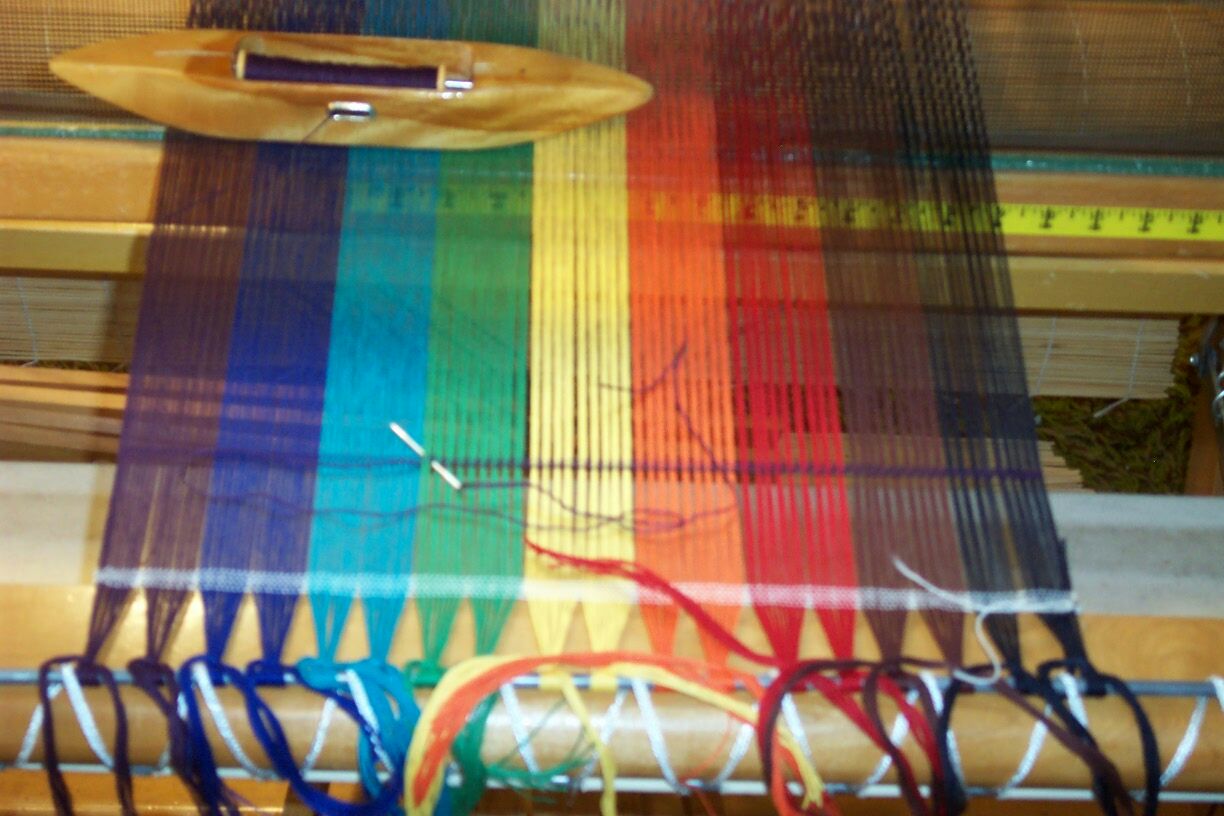
 Colour gamp test warp
One of the things I try to do is have the maximum amount of output for the least amount of input. What that means is that I try to do the various tasks associated with weaving with the fewest hand motions possible.
Two years ago, I watched as Syne Mitchell sleyed a warp. It was a colossal duh moment. She was sleying in much the same manner as I threaded. How could I not have seen that sleying could be done in much the same way?
When I got home from that trip, I immediately put the new (to me) manner of sleying into practice. It took about 6 warps to erase the old muscle memory and make this way of sleying into my new default. Yes, I had skipped dents, or doubled dents the first few times, but seriously? – I had those at times with my old way of sleying. :}
Notice the positioning of my hands. My left hand pretty much stays behind the beater, while the right hand stays pretty much in front of the beater.
What makes this method work is the hook. It is made by Harrisville and has a smaller hook on one end for threading, and a larger hook on the other for sleying. It costs just $10.95 US and is worth every penny as far as I’m concerned.
The hook is held downwards instead of upwards. It is gently rounded and never (or rarely) splits the ply of the threads. (It can split the ply of a very gently twisted yarn such as the Bambu 7.)
To sley I separate the threads into their groups, then put the hook through the appropriate dent, capturing the threads for that dent. The hook then keeps that loop of threads on the shank while it dips into the next space to grab onto the next group of threads. Then all the threads are pulled through at once.
I can do up to four dents in one pull. This particular warp the threads have been tied into groups of four, with two threads per dent so I’m just doing four ends (two dents) at a time here.