
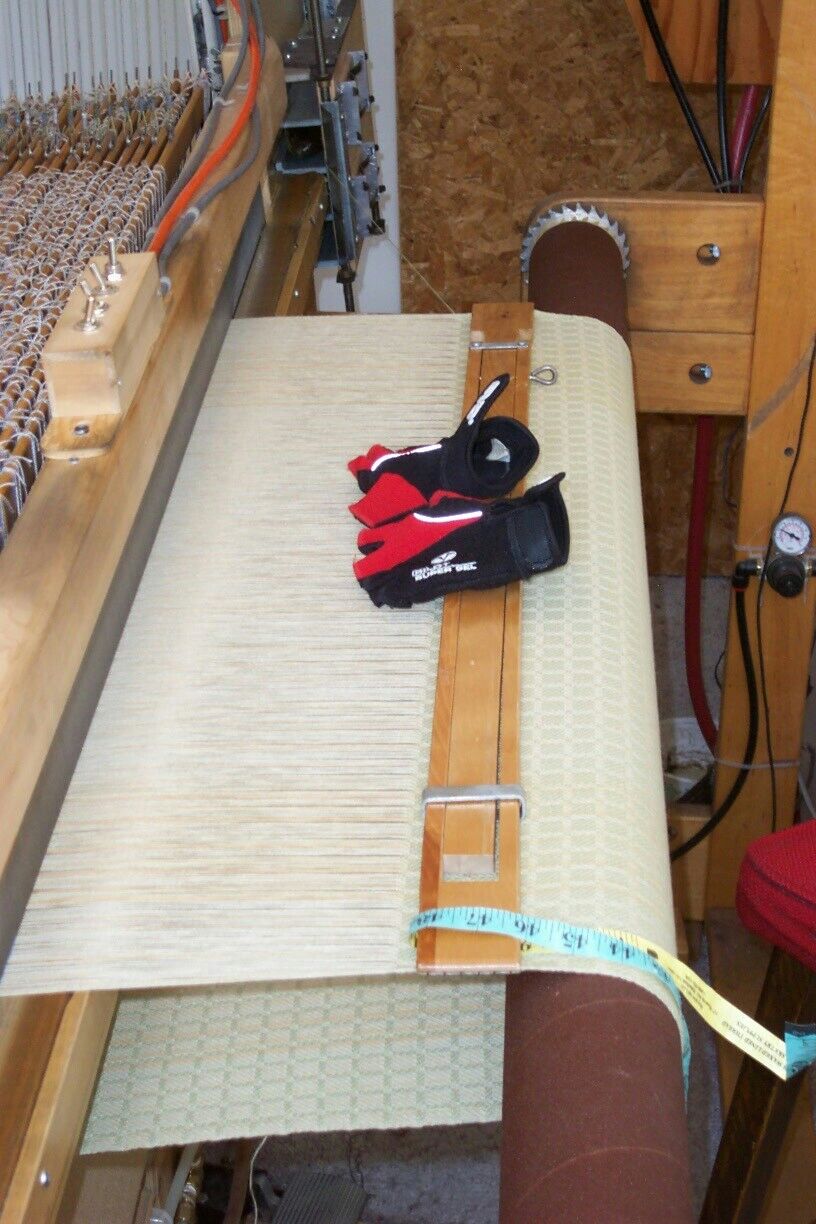
 A temple in use
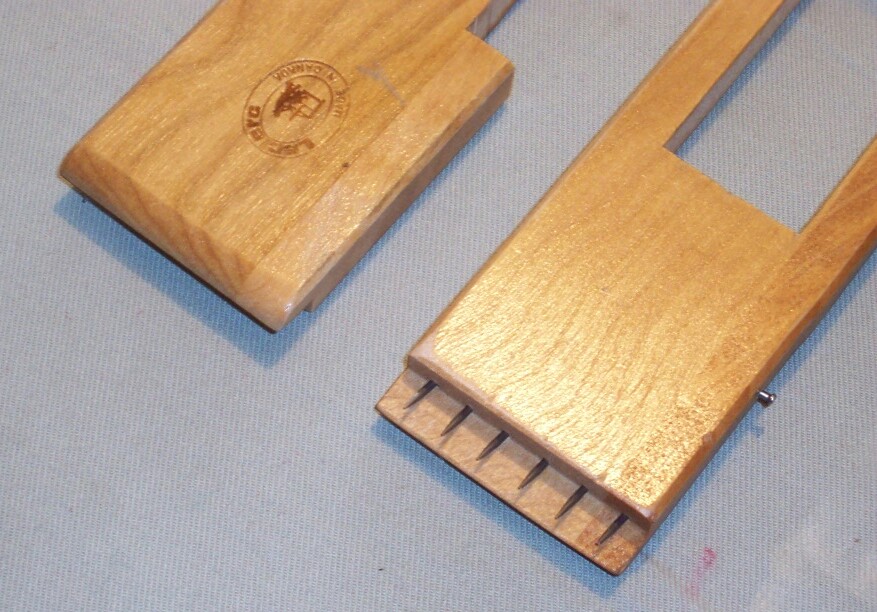
Close up of temple ends – top and bottom
There are several ‘hot buttons’ in the weaving world.
Warping back to front vs front to back.
Floating selvedges
Using a temple
No doubt there are more, but these three seem to crop up at regular intervals, are hotly debated – with no one changing their minds about their stance – then cool off until the next time it crops up.
I’ve gotten to the point in my life and weaving career where I don’t often participate in these debates any more. Got tired of getting flamed for my input the last time. So I’ll talk about my opinion here on my blog and those who want to read can, and those who aren’t interested can ignore my pithy comments. :^)
I’m sure that everyone knows that I am highly concerned with weaving with the highest degree of efficiency that I can achieve. So where do I fall on the temple/no temple debate? Smack in the middle.
Over the years I have tried to weave without a temple because using one really does mean that I weave more slowly. Generally I try to weave without one. But there are times….
So in my experience – for whatever that is worth – I have found that it is necessary to use a temple in certain situations.
When using a fine, fragile yarn
When using (some) singles
When trying to weave a dense fabric – e.g. a worsted fabric (this would apply to weft-faced rugs, generally, too, but I don’t weave them any more)
Quite frankly if I can figure out how to mount ring/rotary temples on my AVL I would use a temple every time I used the fly shuttle, too.
So that is one item on my shopping list for Convergence – to look once more at the Fireside rotary temples. I’ve been told that several people have successfully mounted them on an AVL. If it can be done, I’m confident that Doug will figure out a way. I acquired roller temples, but they are large and don’t fit easily onto the AVL. Unless I’m willing for Doug to do major surgery on the loom, which I am currently not – so I make do with my trusty Leclerc temple when it’s needed.
I don’t use it all that often, but when I do I always know where it is and how to use it.
So for people who have never used one, what a temple does is keep the web stretched out to the width of the warp as it comes from the reed. This allows the weft to be beaten in more tightly for dense fabrics than can be done without it.
It also keeps the selvedge threads from being bent inwards, which for a fragile thread like a very fine yarn or a singles, means much fewer problems with broken selvedge ends. Always a good thing!
What a temple does not do is eliminate draw in once the cloth is off the loom.
For some weave structures, like a 1:3 or 3:1 twill, the shed may not clear properly at the selvedges without the temple, causing floats/skips. Which is why I dragged my trusty temple out for the warp shown above – when I wove this warp in a 2:2 twill I had no problems with skips. But when I changed to twill blocks – argh! The temple sorted that out in a hurry. 😀
There was one warp that I tried to use the temple on, but the wood grain caught on the very fine threads. I nearly bought a metal temple, but decided that – since the fabric was for samples – I’d ignore the selvedges and cut them off later. 🙁
To use a temple, tie on as usual. Weave a header about 2 inches long. Set the temple – bottom up – on top of the warp at the reed. Size the temple so that it is just slightly narrower, or exactly the same width (never wider) than the warp in the reed. You need to have the teeth at about 1/4 to 1/8″ from the selvedge.
Open the temple at the hinge, setting one end into the selvedge about 1/8 to 1/4″ from the edge just below the fell. Set the other side into the opposite selvedge. Push the temple flat and secure with the metal band that prevents the temple from folding. Weave about 3/4 to 1″. Open the temple and move to just below the fell. Repeat.
Generally I count how many picks before each advance, then I weave by counting picks, reset temple, count picks, reset temple. I can get into quite a good rhythm doing this. Of course it’s slower than not using the temple, but I get much better results in the above situations if I do.
As for pricking my fingers – yes, I’ve done that once or twice. I soon learned to not grab the temple in a way that would prick fingers.
In the end, if a weaver is happy with their results, they don’t need to change a thing. But if they aren’t happy …… then looking at different methods might bring them closer to their goal.
Currently reading The Medieval Underworld by Andrew McCall (Doug wanted to read Diamond Age so I’ve left my bookmark in the book and am letting him have it first)