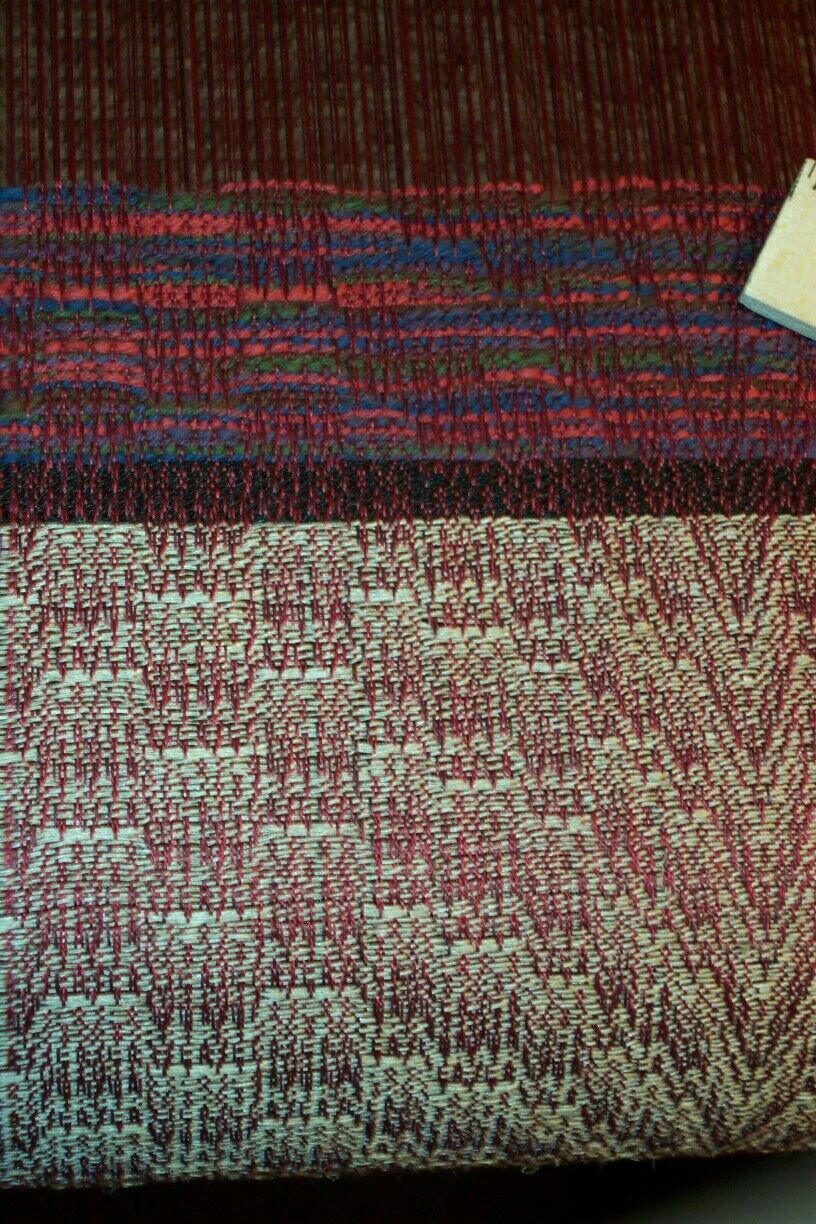
The end of Plan B and the beginning of Plan C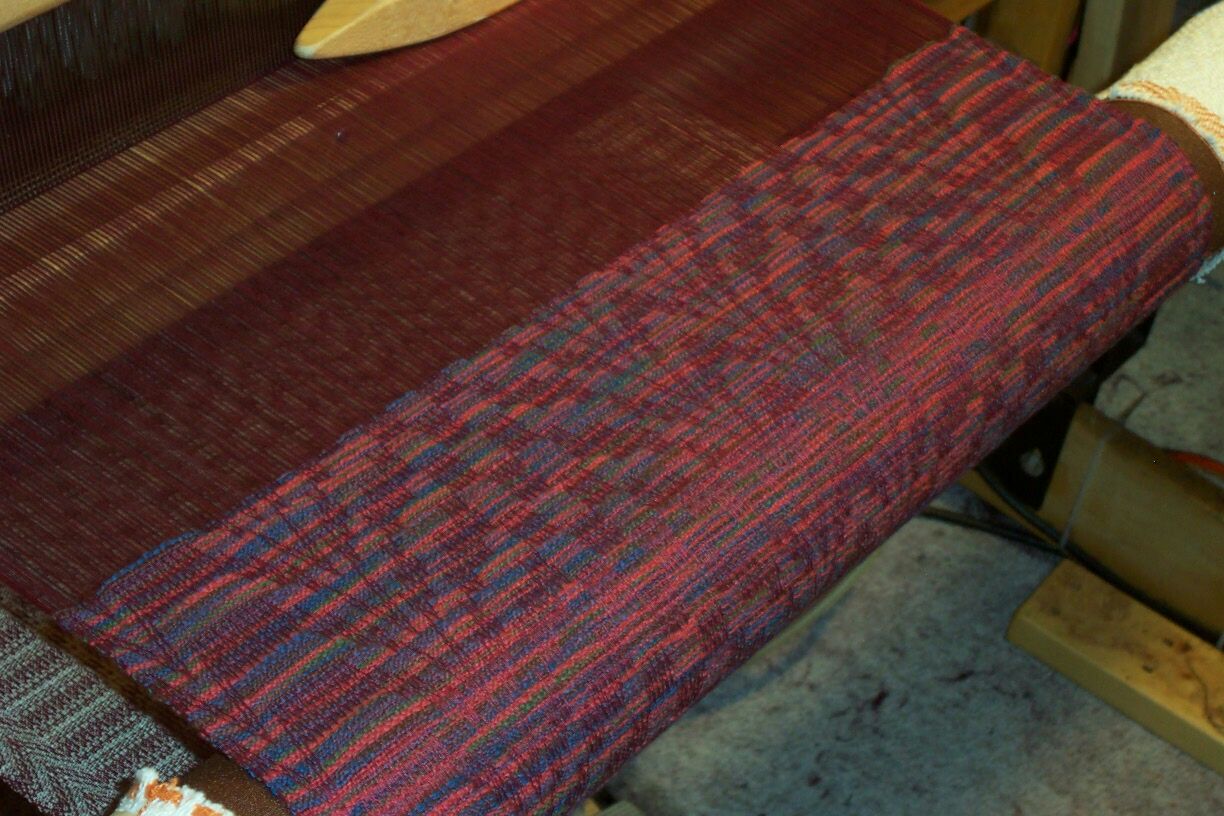
Larger view of Plan C – weft is a varigated cotton slub
I’ve said it before, and I’ll no doubt say it again – one of my goals in weaving is to create the maximum amount of output for the least amount of input. Or Minimum Input/Maximum Output. MI/MO for short.
In the past, when people have asked me about floating selvedges, I rather flippantly replied “Don’t use them – they slow me down.”
Many people seem to get quite perplexed at this comment, asserting that using floating selvedges doesn’t slow them down.
Well, that’s probably because most people don’t weave nearly as fast as I do. :} Not that they can’t, they just probably have never been shown how to weave ergnomically and efficiently.
As I travel around the continent, I find so many people who just don’t know that there is an efficient/ergonomic way to hold and throw the shuttle. Many are happy to have me demo and try it the way I do, but others are quite happy with what they are doing and continue on the way they’ve always done it.
As for floating selvedges, they are a tool – or perhaps I should say a technique – which is appropriate in certain circumstances.
http://www.weavolution.com/node/7250?#new
Read Bonnie Datta’s post #17 for an extremely informative post on how to do a floating selvedge for a weft faced rug.
So when I say I never use a floating selvedge because they slow me down, what I am really saying is that I don’t weave fabric that requires one. Because I don’t want to weave slowly when I can weave quickly.
Therefore, when I’m choosing a twill I never weave huge goose eye twills. The outside threads will fall out of the fabric if you do an extended reverse twill. So, I don’t. If I want to do something like a goose eye, I will thread a herringbone twill and weave it the same way – skipping a shaft/treadle when I change direction so that no threads fall out of the cloth.
To use a floating selvedge on a plain weave or even a straight twill is unnecessary. But there are those who tell me that they can’t weave without one. If that’s the case, they will be hard pressed to build up speed if they want to because no matter what anyone says, it still takes a moment to push the floating selvedge down so that the shuttle can pass over it, interupting the weaving rhythm and therefore reducing speed. And those moments add up.
If the weaver is trying to weave 60″ in width, it will slow them down even further. And forget using a floating selvedge on a jack loom with fly shuttle. The fly shuttle doesn’t know the fs is there and it will simply knock it aside, ignoring it completely.
So no, I don’t ever envision myself using a floating selvedge. If I can’t be perfect, I will be as consistent as I can be. I’ve found that being consistent, holding the shuttle as I’ve demo’d in other posts, will bring about good selvedges much faster than messing about with a floating selvedge.
Now stepping off my soap box……….
p.s. you can click on the second picture to check out my selvedges