I did the proto-type for the silk scarves on my four shaft Leclerc Fanny. It’s a fairly simple undulating twill that I added a short extended run to for a number of reasons, but the short version is that it worked with my numbers. 🙂
It looked like this:
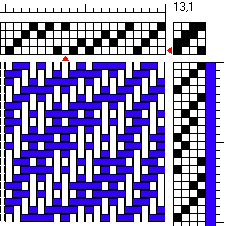
For one warp of two scarves, I was able to weave it off without mistakes, although it meant un-weaving a number of times as I lost track of where I was in the 20 pick repeat and had to go back to find my place again. This level of concentration didn’t appeal to me over the course of a number of warps, many of them longer than the two scarf warp I did initially.
In order to make the whole process easier, I decided for a number of reasons to put the warps onto the AVL.
The twenty pick repeat is actually only 16 as the first four and the last four ends are identical. That meant I could thread the 20 end sequence over 16 shafts as follows:
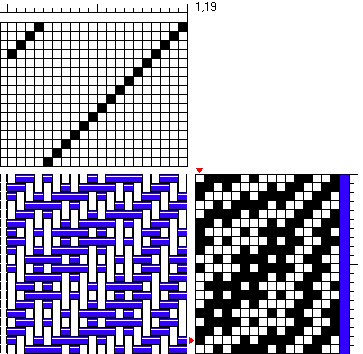
It took about an hour to transpose the tie up to a 16 shaft lift plan – of course I made a number of mistakes! What I did was assign a number to the first 16 ends in the 4 shaft version, then checking the tie up on the four shaft version, indicated on the lift plan all the ends that were to behave as though they were on shaft #1 went up when they were supposed to. Ditto shaft 2, 3, and 4.
When I finally had the liftplan correct there was one more thing I needed to do. At this point the eight threads on shafts 13-16 were at the back of the loom. I wanted them at the front – easier to see for one thing! Using the shaft shuffler tool in Fiberworks, I moved the back four ends to the front four as follows:
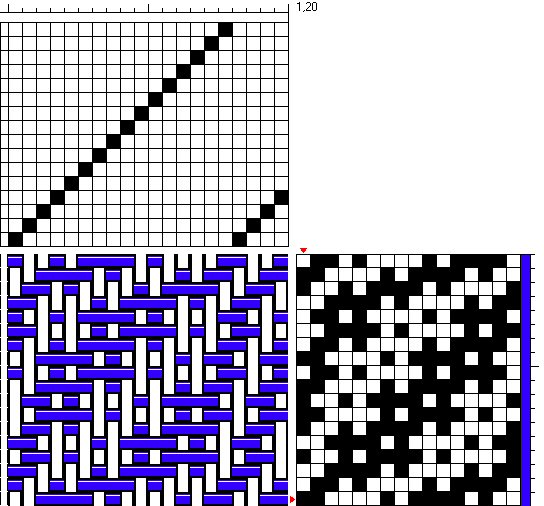
In order to do this properly, I set the drawdown for an ordinary treadle tie up, which revealed one more tie up error! Once everything was cleaned up and the shafts shuffled where I wanted them, I reset the the draft to show the liftplan.
Et voila!
I got the first scarf woven this afternoon and started the next one. I’m hem stitching on the loom so that when they come off they only need to be wet finished and trimmed. Hem stitching is actually faster than fringe twisting, and because the warp is silk, it can be left loose. It might get a little fuzzy, but it won’t start to disintegrate like the regenerated cellulose fibres.
I could have done the whole run of scarves on the smaller loom, but it is much faster to weave on the AVL with the auto-cloth advance. I don’t have to stop every two inches to advance the warp. It is also ‘easier’ on my neck, not having to keep re-setting the tension. Since the loom was behaving (mostly), it took just about an hour to weave the first scarf.
And I can continue putting place mat warps onto the small loom. Or maybe, just maybe – deal with that rayon chenille!