There are routine questions that come up over and over again. Answers to such questions are varied, some more ‘helpful’ than others.
When getting started at the loom, there is an approach I see pretty routinely. The weaver ties on, then begins weaving by jamming the first pick down against the knots as closely as they can.
This can create issues because the weaver simply doesn’t understand why this may not be the best approach.
Yes, you will ‘waste’ a couple of inches of warp, but here’s why you might want to.
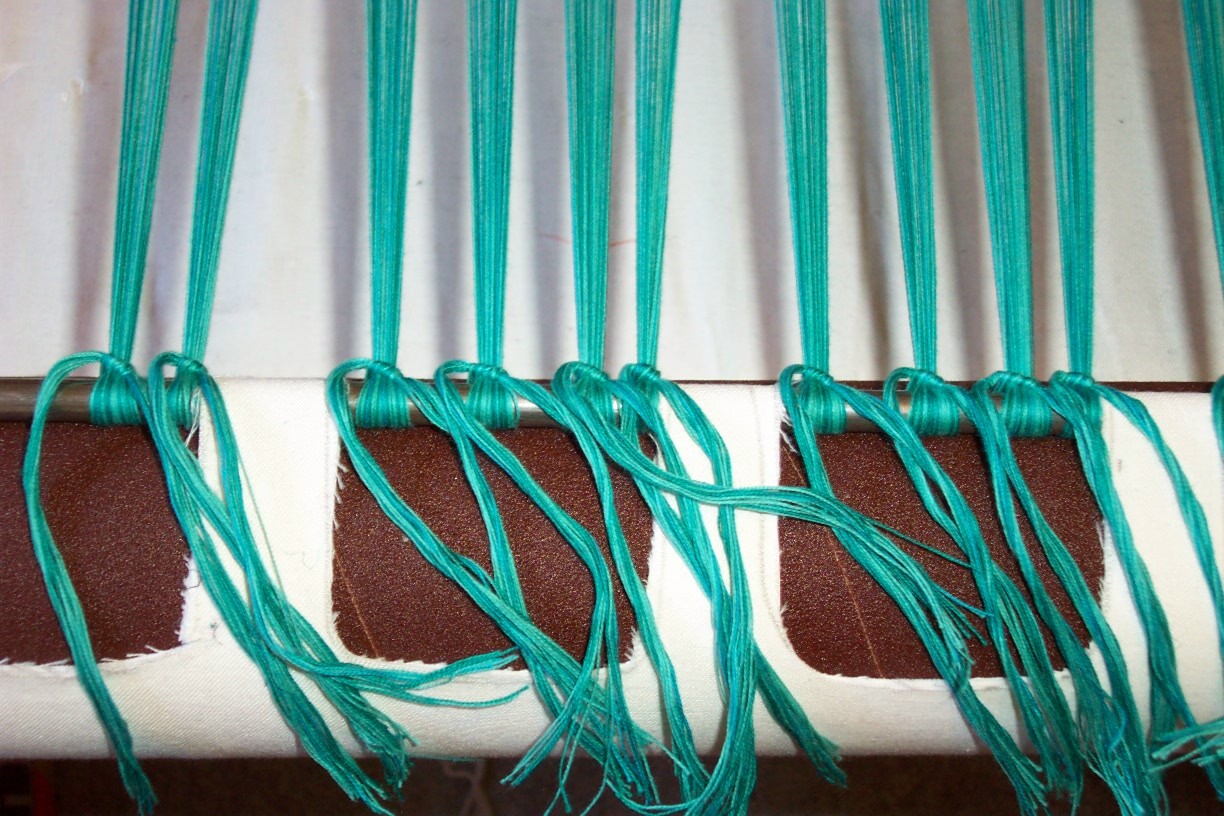
Here is my ready to weave on warp. Yes, I leave long tails. I have large hands and it is easier for me to tie it if I have enough length to handle. The knot I use is called (by some) a ‘surgeon’s knot’. You begin by splitting the bout in half, wrapping each half around the rod bringing the tail up to the *outside* of the bout, then tying it by crossing one tail over the other, and instead of just passing the tail through once, you pass it through twice, and then tighten the knot against the rod. I have information on this in my online classes at both School of Sweet Georgia and Long Thread Media, plus page 46 + in my book The Intentional Weaver.
I like this knot because it has a low profile, and because it has been wrapped through twice, has enough friction to tie most yarns effectively. There are a few exceptions, generally slippery ones where the surgeon’s knot won’t necessarily hold, so I either tie a ‘bow’ on top (using the ‘extra’ length) or I will use an overhand knot and lash the bouts to the apron that way.
Now, if you look closely at the photo, what do you see?
You will see the bouts moving from the reed and becoming narrower as they get closer to the apron rod. IOW, they are at an angle at the edges, become straighter in the centre of the bout.
With that greater angle at the edges of each bout, there is slightly higher tension on the edge threads, and once you add the first weft pick, the warp threads need to find their ‘proper’ place in the web.
If you jam the very first pick down into the apron rod, you will be doing several things. The first is that you are forcing the already tighter edge threads in each bout to make a sharp bend as they exit the knot and begin weaving the web. This might not cause too many issues with your tension, but if you are working with a ‘tender’ yarn for warp, you may find there are tension issues that cause some subtle problems.
The other thing is that if you jam the first pick down against the apron rod, you have left no space to cut the web from the apron rod. As you cut you may cut the apron, or you will cut deeper into your web to release the web from the loom. Since you are cutting into the web itself, rather than loose warp threads, you may find that the web begins to fall apart. If you were counting on that length as part of your finished cloth, you may find that your finished cloth is shorter than planned.
Some people say they do it so that they can use as much of the warp as possible in the fringe they are planning. But again, if you have put wedges into the edge of the scarf/shawl etc., you may not find the effect satisfactory. Instead I do a header, in which I check for threading errors, sleying errors, correct anything that needs correcting, and then measure out the length I want for fringe and leave a gap of unwoven warp to make the fringe and begin the weaving further away from the apron rod.
Some people tie great big huge knots to tie on and make the angle deflection more extreme. Some tie the warp into tiny bouts, which makes getting good tension more difficult, and increases the amount of time required to do the tying on.
I use approximately one inch (2.5 cm) for a bout, split in half and tied. I begin at the right hand side (because I’m right handed and that works ‘better’ for me) and tie each bout in order until I get to the left. Then I go back to the centre, and beginning at the centre I pull the tails of the knot tails toward the reed and gently tighten the warp. I do that for each knot and take the slack out of each knot in turn. And then I advance the warp, tighten it to weaving tension and begin weaving.
Figure out what works best for you and then do that.

Leave a Reply