
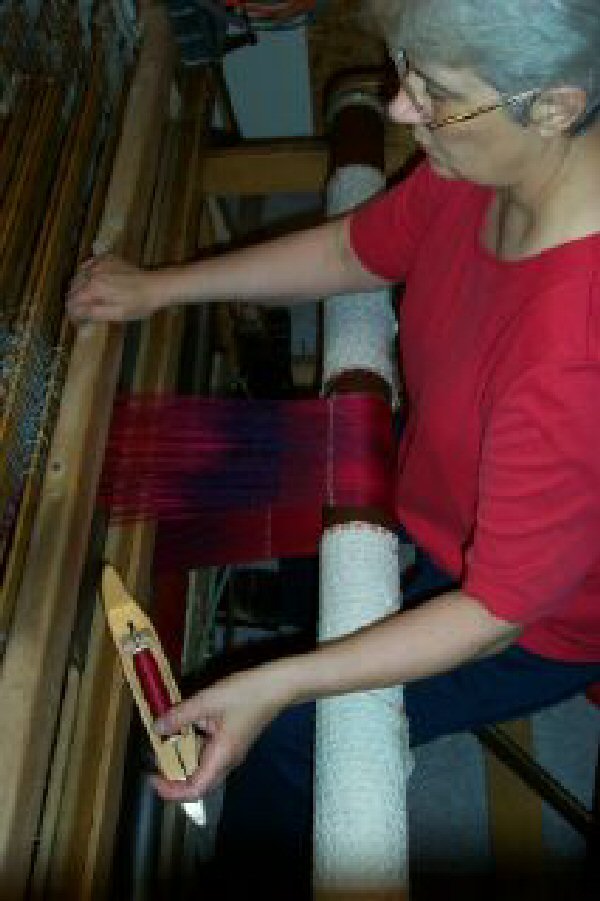
Figuring out the ‘best’ way to weave can be a challenge. I see lots of different people suggesting different ways and they all ‘work’. The problem is whether or not they will continue to ‘work’ if the weaver weaves longer, as in order to meet a deadline. And doesn’t stop and take breaks.
I’ve talked about how to hold and throw the shuttle through the shed. I’ve talked about making sure that a person is sitting up on their sitz bones (look it up). I’ve talked about ‘perching’, not sitting completely on the loom bench. And I’ve talked about treadling, including wearing some kind of protection on your feet. (If you don’t, make sure you stop weaving when your feet begin to hurt.)
But the other day I saw something that I’ve seen before and which could lead to injury.
It is in how far ‘back’ you lean when you bring the beater forward. I don’t know if the person demonstrating the motion is exaggerating for effect, but it is not something I would recommend weavers adopt.
As the weaver is perched on the edge of the bench, the motion is to throw the shuttle, catch it, and holding the shuttle hand slightly higher than the height of the beater to bend slightly – *at the hips* – and move your torso slightly backwards. By bending at the hips the back maintains it’s ‘straight’ position. As you treadle during that slightly ‘reclined’ position, the pelvis does a very tiny tilt to allow the legs to depress the treadles. All of these movements are quite ‘small’. The smaller the movement, the less effort/energy they require.
However, once in a while I see someone weaving and they bend so far backwards that they are no longer on the sitz bones, but back on the sacrum or tailbone.
This exaggerated movement – like most exaggerated movements – is tiring and when done over and over again, can set up inflammation. If the inflammation persists, injury to the soft tissues can begin.
And believe me when I say – it is much much easer to prevent a soft tissue injury than to recover from one.
We can get into habits fairly quickly. Again, much harder to erase those habits in order to pursue ‘better’ techniques. But I have found that adopting what appears to be a much ‘better’ technique is well worth the time and effort to erase the old, and adopt the new.
Leave a Reply