
From time to time I see a ‘reel’ come through on Facebook. Someone will demonstrate a technique for weaving. And I think ‘well, yes, you *could* do it that way or…’ and I watch what they are doing and quietly keep scrolling.
Weaving is not difficult, but it is complex. That means that sometimes people will work out a technique and that approach isn’t particularly ‘efficient’. But if they are happy, who am I to say ‘nay’?
Sometimes the person just figured out a way that worked for them, and they keep doing it that way.
I know I have been guilty of that myself, in spite of working hard to make my processes more efficient. Less annoying. And yet I will watch someone do something, immediately realize that what they are doing is so much better/easier! And then I will drop the way I had been doing it and switch to the ‘new’ to me method.
The two most obvious techniques was the way I thread now, learned from Norman Kennedy in a workshop I took from him. It was absolutely mind blowing, how much more ergonomic it was. It doesn’t always work for every weave structure/threading system, but when it does it is almost magical.
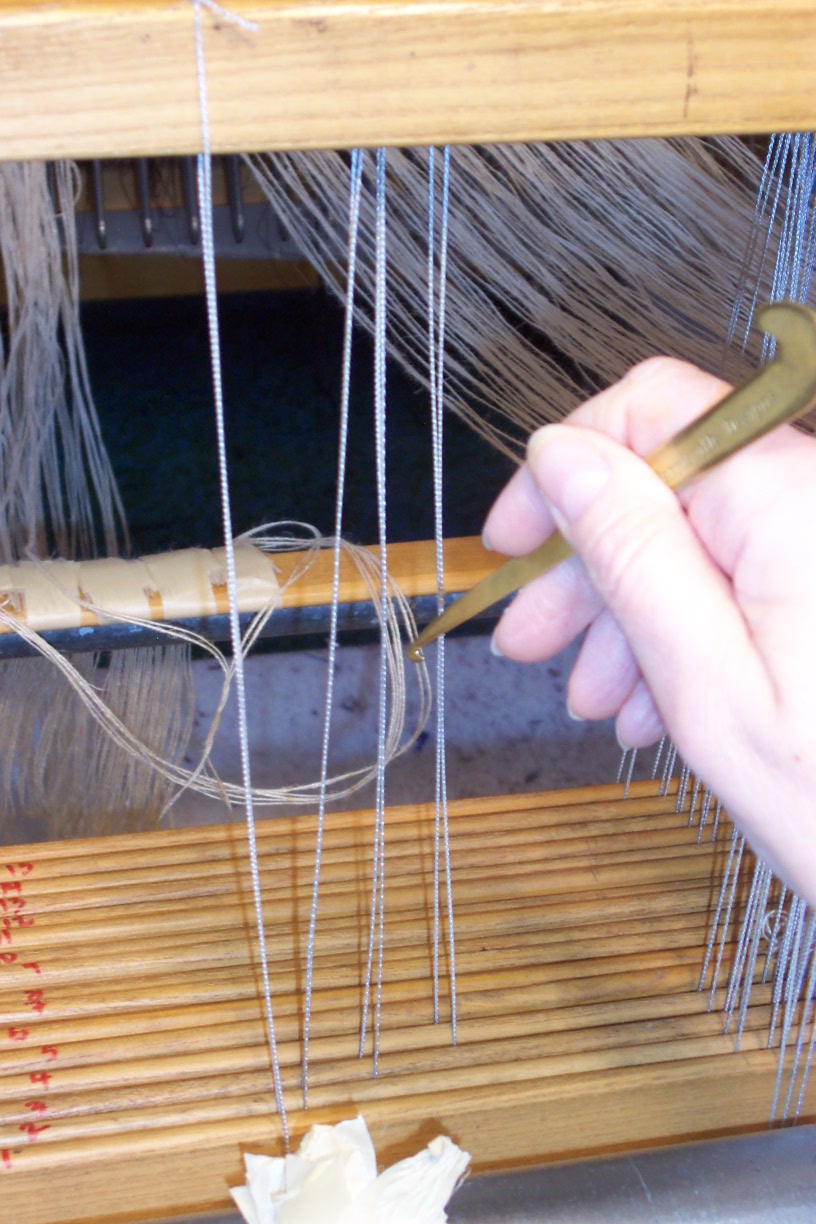
Then watching another weaver sley their reed, and it was wait – let me see what you are doing! I don’t always do it that way, but if the thread is co-operative, that is the method I prefer.
The other one that I figured out by myself (not that I’m claiming to be the only person that does it because it is simple, easy-peasy and quick) related to lashing the warp onto the apron.
I quickly discovered that bouts of about 1 inch work ‘best’ so I group my yarns as I am sleying in bundles of about 1 inch worth, then secure the bundle after sleying in a slip knot. Some people go ahead and tie the bundle in an over hand knot right away. I tend to wait until I’m done the sleying, double check I’ve got the correct number of ends in each group and then tie the overhand knot.
When I begin lashing, I take a length of cord, tie a loop into the end and slip the loop on the apron rod about where the warp will begin, and then *holding the cord under tension* interlace the cord through the bundle above the knot, usually with the shed open to a plain weave or something similarly equally balanced, and pass the cord through the bundle. Then around the rod, through the knot, always keeping light tension on the cord.
Once I’ve done attaching the warp to the apron I tie off the loose end of the cord, usually using 3 or 4 half hitches – something that is easy to tie and easy to release.
At this point the tension on the warp is not consistent, even though I have been holding light tension on the cord. In order to properly tension the warp I first release all tension on the warp. The apron rod will drop down as gravity takes over. Then I slowly start winding the beam up so that the slack in the lashing cord begins to reduce. This is a step that is better done a bit slower, rather than quickly. As the tension is re-applied, the tension on the cord begins to equalize. It is visible in the apron rod which will begin to level. As tension is applied to the warp, the unequal tension in the cord will travel along the cord until the entire cord is the same tension.
At that point I set the weaving tension, weave the header and can begin weaving my project.
No tugging. No plucking. No strumming. No playing the harp, plucking at the individual bouts.
Et voila’! It’s ready to go.
If you do want to check the tension on the warp, just in case? Do not pat the warp. Instead lay one hand flat on the warp near one selvedge, then slowly and gently pull your hand to the opposite selvedge. This way you have a point of reference as your hand moves from one side to the other and you can more easily tell if there is a tension issue.
Bottom line? Do what gives you good results and makes your heart sing.
If you want to learn how I do things, here is the link to my classes at School of Sweet Georgia.
Leave a Reply