
I frequently see advice to new weavers which is well meaning but not exactly helpful.
Regarding draw in: lay your weft into the shed at a 45 degree angle.
It sounds good – until you know what a 45 degree angle looks like. And that it is simply impossible in most instances to achieve a 45 degree angle on the weft in the shed of most looms.
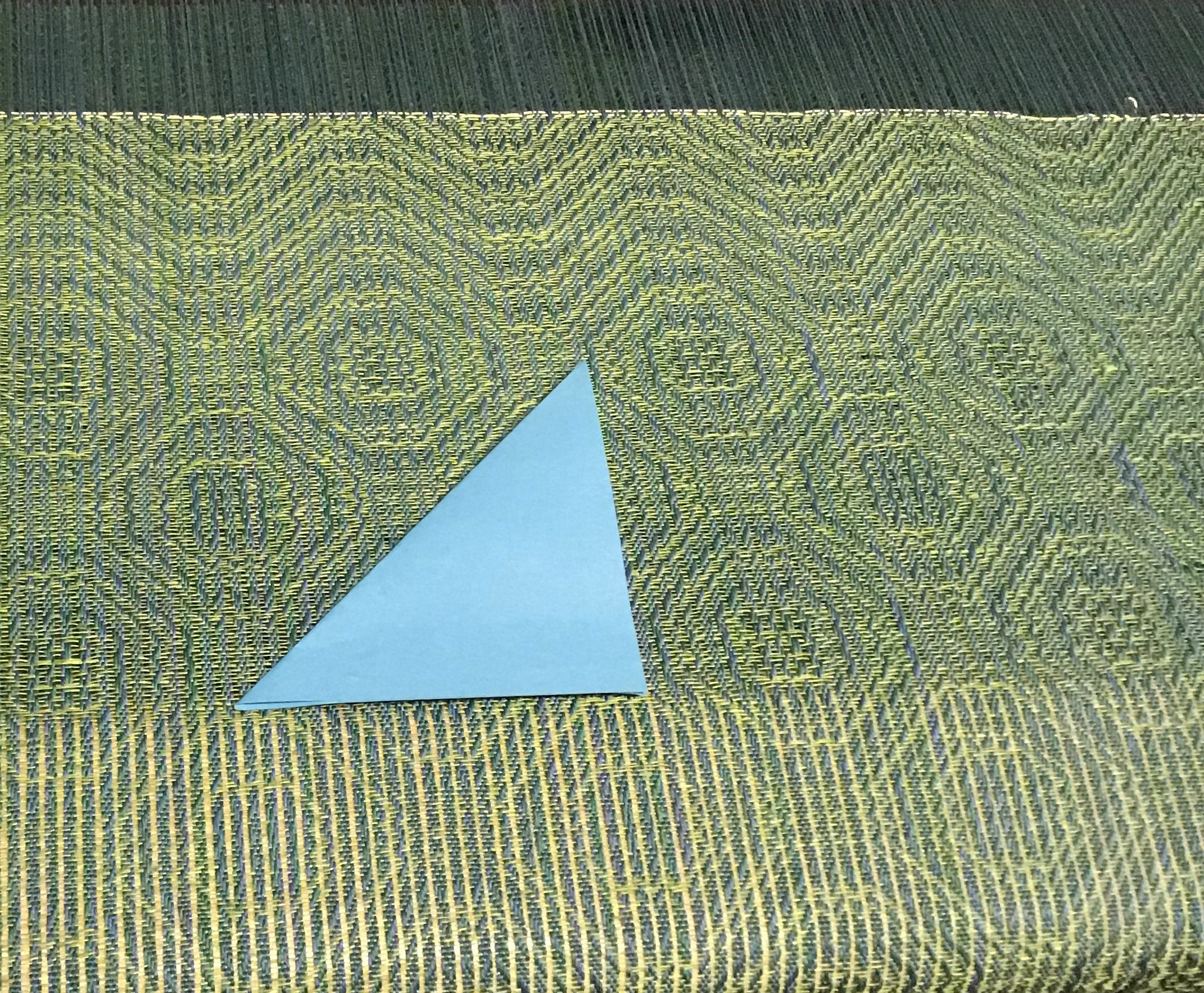
Now, I frequently check my *twill* angle with a small triangle that I make by taking a Post-It Note and folding it on the diagonal to create a 45 degree angle. (see photo)
Now, imagine that your weft is meant to be travelling at a 45 degree angle from the selvedge of one side of your web to the other selvedge.
See the problem?
It can’t be done.
So people say to ‘bubble’ the weft in the shed. Which generally (for ‘standard’ warps) means leaving too much length of the weft in the shed which creates small ‘bubbles’ in the weft. Bubbling is typically most effective in weft faced cloth that requires ‘extra’ weft length in order to travel over and under the warps and cover it completely.
New weavers panic about ‘draw in’. Draw in is going to happen. It will happen a little, or a lot, depending on the fibre, the density and the weave structure.
Generally the ‘rule’ is that draw in should not be more than about 10%, which means on a 10″ wide warp the maximum draw in should be 1″ or less. On a 40″ wide warp the draw in should be less than 4″.* Generally, the wider the warp, the closer to 10% draw in will be. IOW, on a 10″ wide warp, draw in might be closer to 1/2″ (1/4″ each selvedge).
On a 40″ (or more) wide warp, it might be most helpful to use a temple and hold the web to the width in the reed, BUT THAT DOES NOT ELIMINATE DRAW IN ONCE THE WEB HAS BEEN REMOVED FROM THE TENSION OF THE TEMPLE/LOOM.
However, the temple will reduce abrasion of the reed rubbing against the selvedge threads and therefore will help prevent breakage of the selvedge threads during weaving.
But draw in is a function of the weft travelling over and under the warp threads and once the warp and weft balance out their path over and under each other, the web WILL contract – as in ‘draw in’.
Some weavers try to counteract the draw in by leaving ‘loops’ of weft at the selvedge. What this results in is unstable selvedges. Some people then insist that selvedges MUST be plain weave. No, they actually do not. They need to be stable and consistent (mostly) but even consistency is not entirely required. l have purposefully woven cloth with a scalloped edge on the selvedges – on purpose, as a design element.
Anyway, you can find out all sorts of things like this in my books, in previous blog posts, or during the seminar series. I’m just wrapping up the first offering, and will be launching registration for the next on Dec. 2. Early bird pricing for the first week.
If you want my books, there is a link on my website to blurb where you can purchase The Intentional Weaver, Magic in the Water (booklet), and Stories From the Matrix. There is a link to my ko-fi shop where you can purchase other monographs that I have available there.
*typo corrected
Leave a Reply