I’ve been seeing posts online about books and AI. It appears that AI businesses are buying up rare books, destroying them by cutting them apart in order to scan them, upload them to their ‘cloud’ and then trash the original pages.
So far as I’m aware, no AI has scanned my book, possibly because I don’t appear on any publishers catalogue, being self-published. But I suppose that at some point they will target companies like blurb and begin to rip through these ‘small’ (in terms of publication runs) books and absorb them, as well.
In case anyone wants to know, none of my books have been written with the aid of any kind of ‘artificial intelligence’ as they were written before AI really hit the market. And I continue to refuse to ‘prompt’ AI in order to write my articles.
Now, of course, with the rise of AI, people like me are finding our work screened for signs of ‘AI’ usage.
I would like to point out once again that ‘AI’ does not actually know how to weave; therefore any ‘lessons’ they try to share are suspect. It’s gotten to the point where I look at illustrations online and cringe because so many are so obviously AI generated and *wrong*.
Over the course of the upcoming seminar series (and if I do another in the new year, as I hope to do) I will be mentioning some of my resources that I use. I posted here about some of the books I mentioned in the first seminar last Sunday. And I expect to discuss more as each seminar airs.
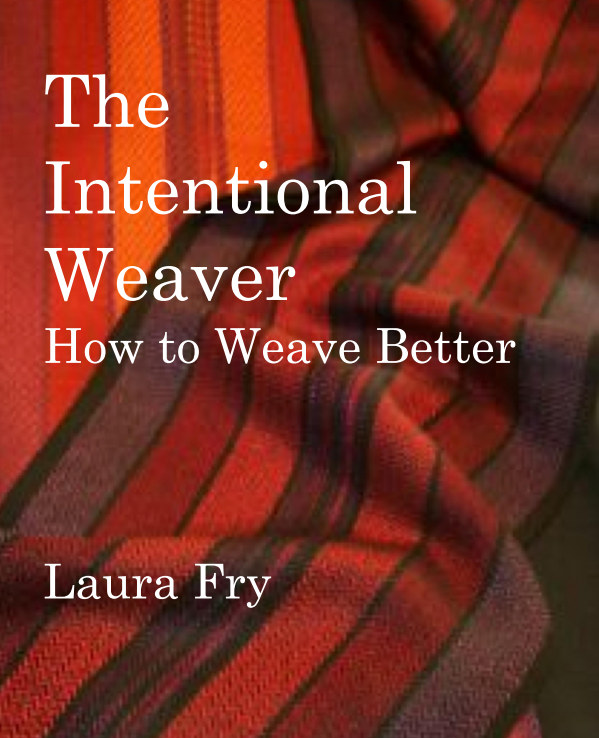
Some people may notice a similarity between my book title and one of Judith MacKenzie’s – The Intentional Spinner. In case you are wondering, book titles are not subject to copyright protection. Also, I had hoped to co-auther a book with Judith, but she’s a busy person and it didn’t happen. But I wanted to retain that perspective of learning and practicing weaving with an intentional mindset.
Weaving is an act of creation. But that doesn’t mean it should be done thoughtlessly. I have seen some groups of people demean some teachers, insisting that the goal of the teacher was to ‘destroy creativity’.
I hope that none of my students think that applies to me. What I am *trying* to do is explain some of the aspects of the craft that need to be paid attention to, if the weaver wants to make a cloth that will perform the use that it was meant to perform.
After hearing this claim a number of times, I went looking for quotes on creativity by well known and acknowledged ‘masters’ of various arts/crafts. One of the quotes (I forget the person) was ‘learn the rules so that you know how to break them correctly’.
My attitude is more, learn the fundamentals of the craft so that you can apply them to create your unique vision.
The ‘rules’ are a framework. It is up to each and every practitioner to decide if those rules are bendable, and by how much. None of that happens without intention.
The seminar this Sunday is The Efficient Weaver. I will talk about how to work ergonomically which means with the least harm to the body. As a consequence of working ergonomically, the result is that the body works more efficiently. And you can do more with less effort. In a craft that is extremely labour intensive, I ‘intend’ to keep weaving, to the best of my ability, for as long as I am able. Not harming my body will help me in that goal.
But we all get to choose what that means to us.
Leave a Reply